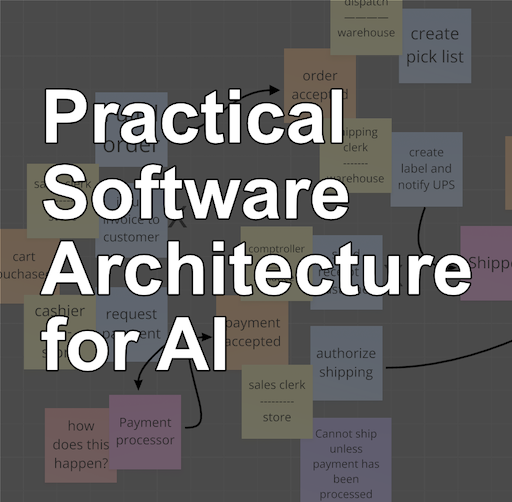
Practical Software Architecture for AI (And Everything Else)
$1,295.00
10/7–10/9, 2024, 9:00AM-12:00PM US Pacific Time
Coding skills alone are not enough to get or keep a job in an AI world, no matter how good you are. In this class, you’ll learn the architectural skills and systems thinking you need to use AI in a way that yields a scalable and extensible system.
11 slots remaining
Practical Software Architecture for AI
(And Everything Else!)
Coding skills alone are not enough to get or keep a job in an AI world, no matter how good you are. In this class, you’ll learn the architectural skills and systems thinking you need to use AI in a way that yields a scalable and extensible system. Architecture is a core technical skill, maybe more so than coding—essential if you want to stay relevant, whether or not AI is on the scene. You’ll walk away from this class with those skills.
A perfect implementation of an inappropriate architecture is a liability. You’ll learn to create effective architectures that make your system easy (and less expensive) to build, maintain, and scale, whether or not an AI helps with the coding. You’ll learn how architecture impacts how you work, touching everything from process to organizational and team structure. A team can’t work effectively when it fights the architecture to make small changes, and agility becomes impossible.
There isn’t an LLM on the planet that understands architecture. An LLM can code, but it can’t design, because design requires judgment. Without your help, the AI produces a bag of unmaintainable goo that “drifts” gradually into systems riddled with mysterious bugs that can’t scale or adapt easily to new requirements. You can’t just specify features in your prompt and hope for the best; you must tell the LLM how to build those features in the context of a specific architecture. In this class, you’ll learn about practical architectural approaches that can rein in the chaos and reduce AI-assisted modification and debugging costs by an order of magnitude.
There is no one-size-fits-all “best” architecture, however. An architecture that’s appropriate in one context works against you in another. You’ll learn several architectural approaches in this class and how to combine them to create an optimal architecture for the problem at hand. Architecture is all about informed trade-offs, and this class shows you how to make them.
In this class, you’ll learn how to:
-
Create effective software architectures for your products and systems, whether or not AI is involved
-
Create architectures that welcome changing requirements and facilitate teamwork without adding dependencies that can slow you down
-
Design systems that support AI-assisted software engineering, make it easy to incorporate the code the LLM writes, manage contexts effectively to improve accuracy and keep token costs down, and limit the blast radius when the LLM makes a mistake
-
Acquire a palette of architectural approaches and patterns that help organize your thinking.
-
Make effective architectural trade-offs
-
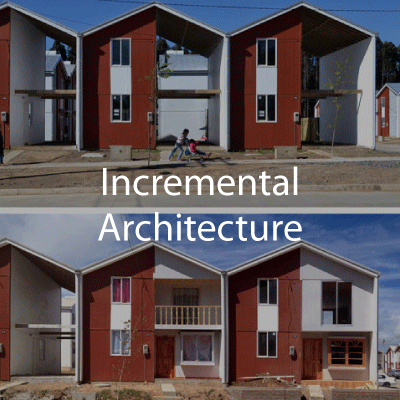
Design systems that can evolve incrementally over time. Incremental architectures start simple, and grow as you learn as the need for scaling emerges
-
Design “Agentic” (LLM-based) software systems based on modern component architectures (agents, microservices, components-in-a-monolith, etc.)
-
Design systems that work well in distributed or cloud environments, are highly reliable, secure, and fault-tolerant.
-
Build effective APIs for both human and intelligent agent-to-agent communication
-
Design domain-focused event-based systems using DDD and event storming (particularly well-suited to rapidly changing requirements and discoveries made in tight customer-feedback loops)
Outline
What is architecture?
Implementation independence
The role of the Architect
Architectural and systems thinking
AI-appropriate architecture
Addressing AI drift
Components and context management
Taming the AI assistant
Adding architectural skills to Claude
Incremental product development and architecture
Last responsible moment (decisions not made)
Integrating coding and product development
The inspect-and-adapt loop.
Architectural coherence when developing incrementally
Architectural decision records (ADRs)
Working with architectural patterns
Systems of interlocking patterns
Managing trade-offs
Architectural characteristics
Defining -ilities
Structural architecture
Conway’s Law
Entities, aggregates, agents
Dependencies
Cyclic and acyclic dependencies
Stability and volatility
Dependency inversion
Layered architecture
N-tier
Sinkholes
Abstraction Layers (hardware, OS)
Hexagonal (port and adapter) architecture
Open-closed principle
Interface segregation
Layering
Port-and-adapter messaging
Dataflow across boundaries
Distributed architecture
Deutch’s Fallacies of Distributed Computing
Inter-service communication
Brokers and proxies
Logging, monitoring, and observability
Story-focused architecture
What is a story?
Thin vertical slices
Stories vs. use cases
Story-driven decoupling
Services
WET and DRY
Discovered, not invented
Problem statements
The 4 C’s:
Communication, collaboration, confirmation, and “cards”
Strategic planning, not estimating
Responsibility-driven design
Single-responsibility, Common closure
Interface segregation, Common reuse
CRC: Class, responsibilities, collaborators
Nested responsibilities and Story Agents
API design for orchestrated systems
REST APIs
Error recovery
Idempotency
Workflow analysis
Narrowing stories
Converting stories to a domain model
Design by Coding: deriving declarative APIs from stories
Component architectures and microservices
Testability
GUI, logic separation
Components and AI contexts
Opaque components, impermeable boundaries
Liskov substitution
Data (and database) encapsulation
Fault tolerance: circuit breakers and bulkheads
Microservice characteristics that differ from other components.
Agents
Presentation, abstraction, control
Micro front ends
Domain-Focused Architecture
Event-driven (messaging) architecture
Choreographed vs orchestrated systems
Proxies and brokers
Queues and publish/subscribe
Event payloads
User, transaction, and request IDs
Lightweight messaging systems
ZeroMQ (brokerless)
Kafka (brokered)
REST-to-messaging portals
Transaction management
Error detection and recovery
Self-scaling systems
Naming services
Lambdas
Domain-driven design
Event storming
Converting the event model to a static model for implementation
Implementation traps & pitfalls
Agentic AI Architecture
Adding “intelligence”
Micro-agents and macro-agents
LLM integration
Talking to LLMs through public interfaces
The model context protocol
Local vs Cloud LLMs
Selecting a model
Ollama, Pydantic, and Docker
Orchestration and the judge
Security
Risks and guardrails
Data vulnerabilities
The LLM doesn’t understand configuration
Prompt injection
RAG and accessing local databases

Allen Holub
Allen Holub has been writing software since dinosaurs roamed the earth, starting in high school on an IBM 360/65 enthroned in a glass-walled temple and fed punch cards by white-clad priests. Since then, he’s written two operating systems and several compilers and contributed to several commercial and open-source products, all without punch cards. He’s been a CTO for early-stage startups and a Principal Architect for a medium-sized one. He’s authored a gazillion articles and a dozen books, some used as texts at U.C. Berkeley, MIT, Cal Tech, and IIT. He was a contributing editor at Dr. Dobb’s Journal and JavaWorld.
Allen speaks internationally, consults, and teaches practical software development processes and software architecture. He has been an independent consultant for decades, helping hundreds of clients become highly effective (faster, better, delivering sooner) at creating products that customers love. Allen works with all levels of the organization, from the CEO to sitting down and mobbing with the teams. He was the Chan-Norris Distinguished (no less) Professor of Computer Science at Mills College.
Allen plays the piano, rides a bicycle, and flies small airplanes, but not at the same time.